People have always been drawn to water. The richest folk built themselves palatial baths, with access often tightly segregated by class and gender. Ordinary people bathed in rivers, streams, lakes and springs, in a relationship that moved with the seasons.
As people moved into towns and cities, they continued to find outdoor bathing spots. But dignitaries often raised concerns about water quality, safety, and ‘respectability’. In 1846 a law was passed to encourage the building of indoor public baths, and Stroud’s first indoor public baths were built in the 1860s (its remnants can still be seen in the basements under Bath Street).
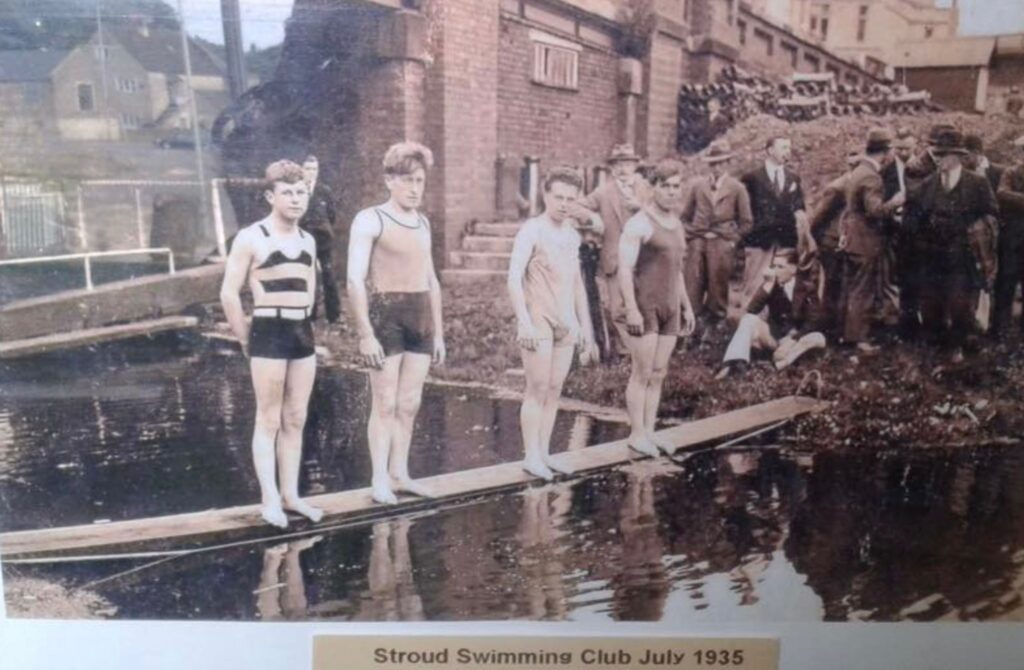
Supervised swimming access in local rivers and canals was sometimes negotiated (including the Stroudwater canal, until 1936), but access was usually only for males, and safety and water quality remained concerns.
The twentieth century brought more summer leisure time for most people, thanks to regulation of working hours for adults and children. Pressure for better access to outdoor bathing spots grew.
By the 1920s and ‘30s, the need to provide safe outdoor swimming, and the need to boost the local economy, led to the building of lidos across the country.
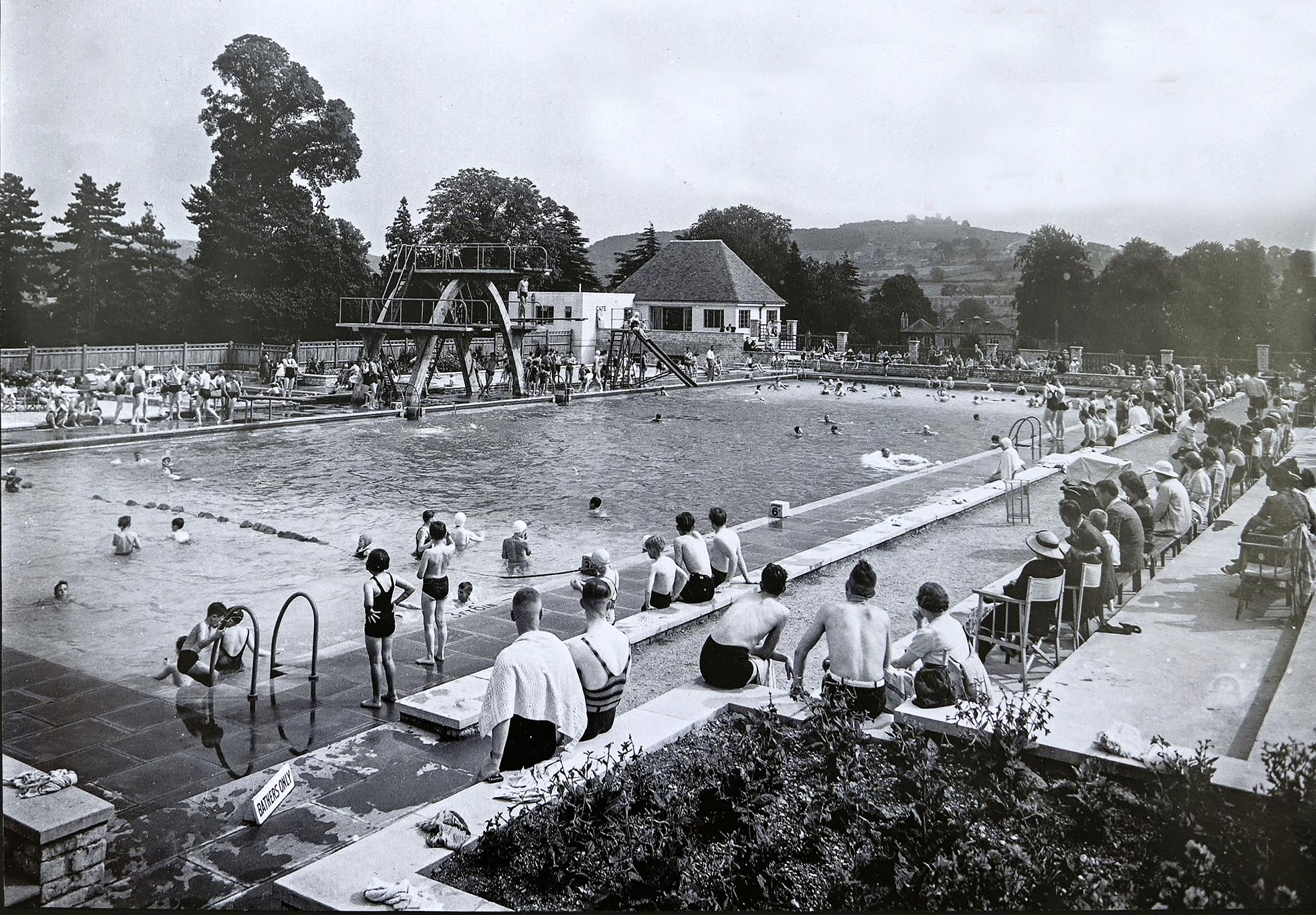
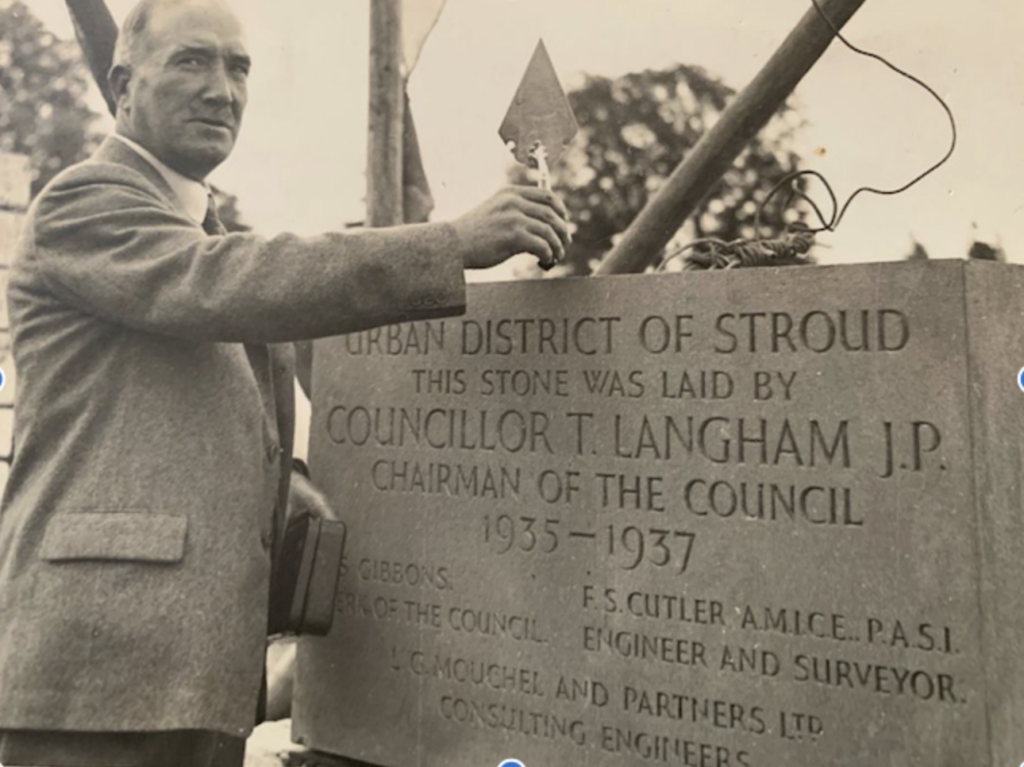
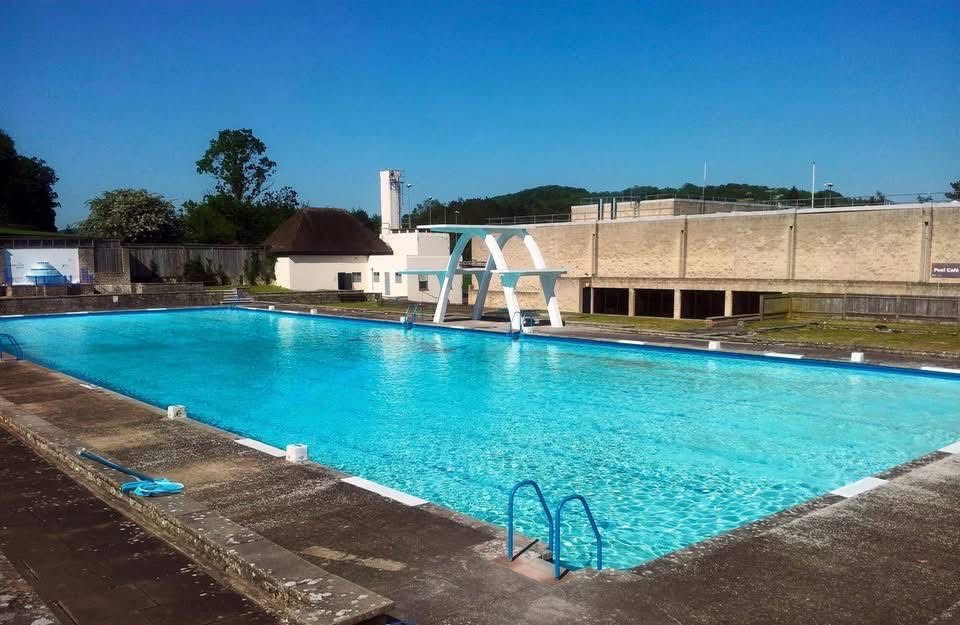
Councillors were being elected who were committed to the ideas of both public health and municipal luxury, accessible to all. In Stroud, in 1936, after years of wrangling, building started on Stroud’s Lido, and a year later the first Labour Chair of Council, Tom Langham, finally unveiled the opening stone for a 50-metre pool set in tree-filled parkland and fed by the highly reputed waters of Callowell spring. (Cllr Langham’s grandchildren and great-grandchildren still swim there).
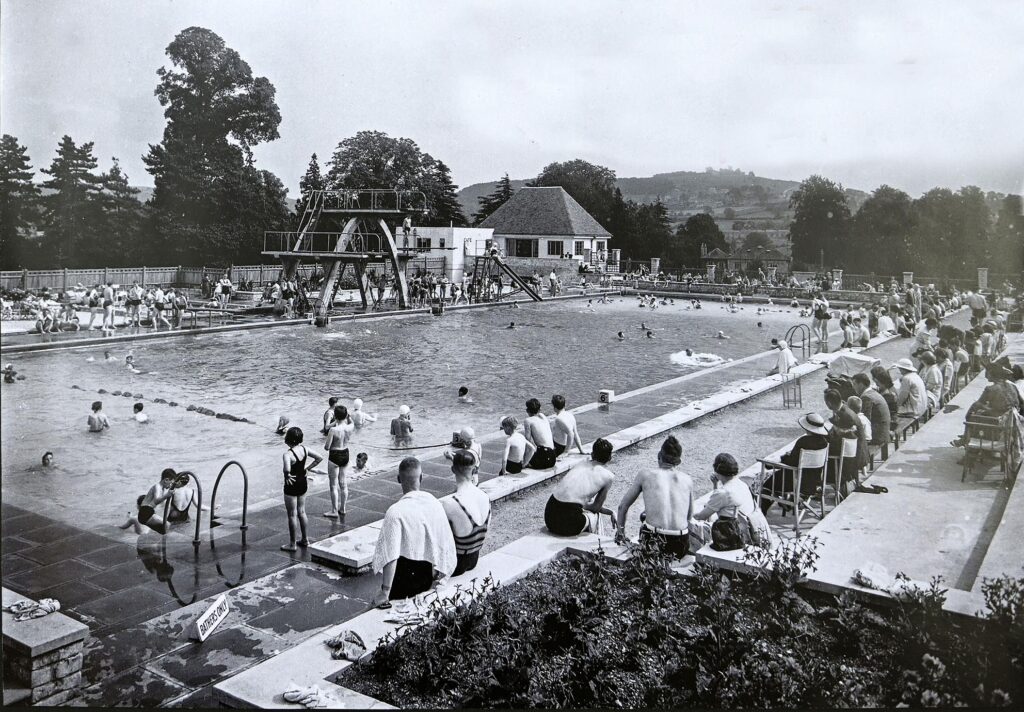
Most 1930s Lidos, including Stroud’s, were built in a modernist style – simple, durable, and designed also to evoke the art deco stylings of European resorts (hence the name ‘Lido’, after the Venice Lido, although the official name in Stroud varied over the years, and to many, it will always be simply ‘the outdoor’).
Lidos weren’t just places to swim, but places to relax, play, get fresh air and sunshine, meet up, show off, hold galas and events, to see and be seen. They were built with cafes, decks, sunbathing, viewing and promenade areas (as can all still be seen at Stroud’s Lido, though the cafe pavilion has been rented to a nursery).
They were designed to boost health, and to bring communities together – vitally important, in the shadow of the depression years and the turbulent, divided politics of the 1930s.
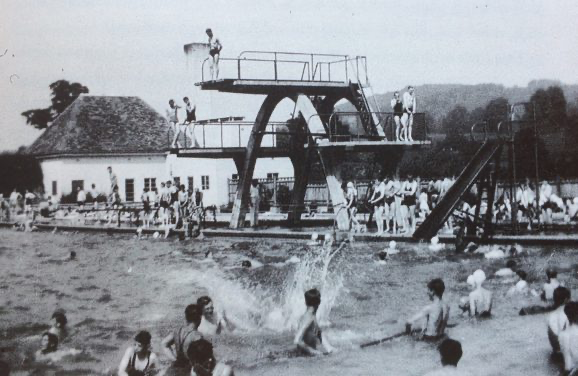
At the opening of one 1936 Lido the local MP said that bathing gives “rich and poor, high and low…a common standard of enjoyment and health”, adding: “when we get down to swimming, we get down to democracy”.
In 1937 another Lido was opened with the following words from its MP, also a health minister: “any money which may have been expended upon (the pool) will come back a hundredfold, not necessarily in cash, but in health, which is better than wealth”.
A bright spot
Most British lidos, including Stroud’s, stayed open during the war, and in the postwar austerity years and the decades that followed, they provided a bright spot (literally – most stayed open during summer evenings, and were illuminated).
They tended to be run by dedicated pool managers – like Mr Elias, who used to turn up to work in a suit to watch over Stroud’s outdoor pool, its users and lifeguards, and whose grandchildren and great-grandchildren swim in the pool.
Lidos everywhere continued to provide generations with exercise, spectacle, and relaxation. Romances were kindled, families were entertained throughout the holidays, young people were kept out of trouble, sports-folk trained, and children learned to be safe in deep, cool water.
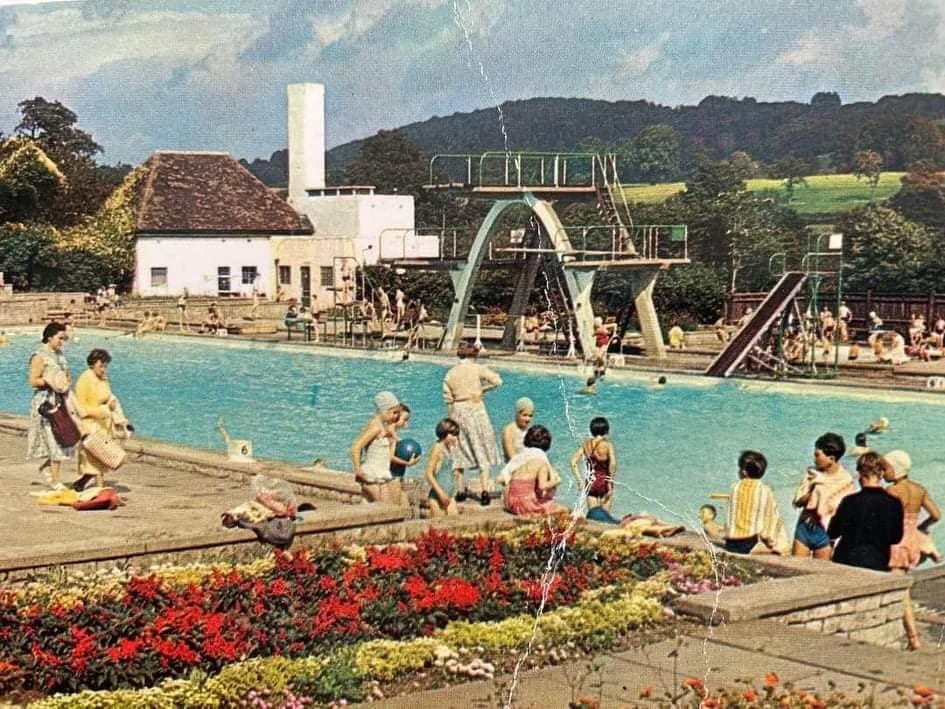
But in 1960, a government report suggested that outdoor swimming and exercise was outdated, and that new pools and leisure facilities should be built indoors. So during the 1970s, many councils built indoor pools and leisure centres. Stroud’s was built in 1972, on the site of the former outdoor ‘baby’ pool. Some outdoor pools around the country were closed immediately, some suffered neglect and closed a bit later – and others were fiercely defended.
The 1930s pumps, filters and concrete pool linings of most Lidos were built to last – they’re still working fine at Cheltenham Lido, for example. But they do need annual maintenance.
Decline – and rise?
By the 1990s, many councils, including Stroud, had been made to outsource their leisure centres and pools to private operators. Some Lidos were closed immediately – others were treated as an afterthought in the leisure contracts, including at Stroud. In an era of economic boom, the ‘mini-break’, and £1.99 flights abroad, the need to provide local outdoor swimming seemed simply old-fashioned, to those setting policy. Effectively recruiting, training and managing seasonal staff depends on a strong connection to local populations, but in this new era, facilities were often managed by people who lived more distantly.
Over time, this lack of focus started to show. Popular features like fountains, diving boards, slides and cafes were closed to public access (as at Stroud), or removed altogether, with concerns about minimising risk of being sued also playing a part. Those managing outdoor pools saw year-round indoor leisure centres as easier to run, and a more predictable source of steady income.
In the last few years, access to swimming has become still more constrained, especially for young people. Restricted session times, booking systems that require a card to book a session (systems often brought in during COVID) make it difficult for young people to act independently and spontaneously, meaning some sneak in without paying, or simply go to less safe and supervised environments.
With political imagination and commitment…
Across the country, imaginative solutions have emerged to the challenges faced by Lidos – often with a combination of council ownership and charitable operation (as at Cheltenham and Wootton). In Stroud, since the council took back over operation of the Lido and leisure centre 2 years ago, some improvements have been made in the indoor centre (including a return to simple systems of coloured bands and queuing to manage periods of high demand). But Stroud’s outdoor pool has remained hard to access and poorly publicised, with attendance numbers far more restricted than at other Lidos.
Lidos can thrive by remembering what has always been important to them – good publicity, generous opening hours during the warmer months, a sensible approach to numbers allowed in (recognising many come to relax as much as to swim), and recruitment that is embedded in the local community. Secondary income streams are crucial, such as cafe provision, events and event hire, pavilion rental, cross-marketing and cross-fertilisation with neighbouring facilities. Hot food and drink can increase appeal and income, especially at cooler times.
It’s also worth noting that around the country, plenty of pools remain heated only by the sun (a cover helps retain heat). By August/September the water in Stroud’s lido has typically reached a balmy 21-22 degrees C.

As other Lidos have shown, with political imagination and commitment, operating costs can be met, and capital can be found to gradually restore them to their former glories, doing work over the closed seasons.
Particularly for young people the employment and volunteering opportunities at Lidos can also boost employability.
Where now?
Young people have had a rough few years. Gloucestershire young people said that improving access to exercise facilities and places they could spend time outside were their top priorities for improving mental health, in a recent survey. Nationally, young people are worryingly pessimistic about their health and wellbeing, and at present the majority of children and young people report not spending any time outdoors enjoying green space, in an average day.
Otherwise inactive people are twice as likely to do swimming (and be recommended swimming by doctors) as any other form of exercise (because it is gentle and non-impact-bearing, and mentally soothing). Spending time in or near water outdoors, is strongly associated with better health outcomes , and swimming outdoors is strongly associated with reduced depression and anxiety. Swimming provision, particularly the Lido, is more valued by Stratford Park and Leisure Centre users than any other feature, according to a Stroud council survey this year, which also showed 71% of Stroud’s leisure centre’s users used the Lido – 66% of them, within the last year.
Clearly, protecting outdoor swimming provision is one of the best ways to boost an area’s health – without which, the economy suffers too.
Lidos also boost social cohesion. No-one is in fancy clothes – everyone is the basically the same in their swimming costumes (and, mostly, people aren’t on their phones!). As one regular Lido user, observing her little boy playing happily with some older kids, said: “age doesn’t matter at the Lido”.
Age doesn’t matter at the Lido
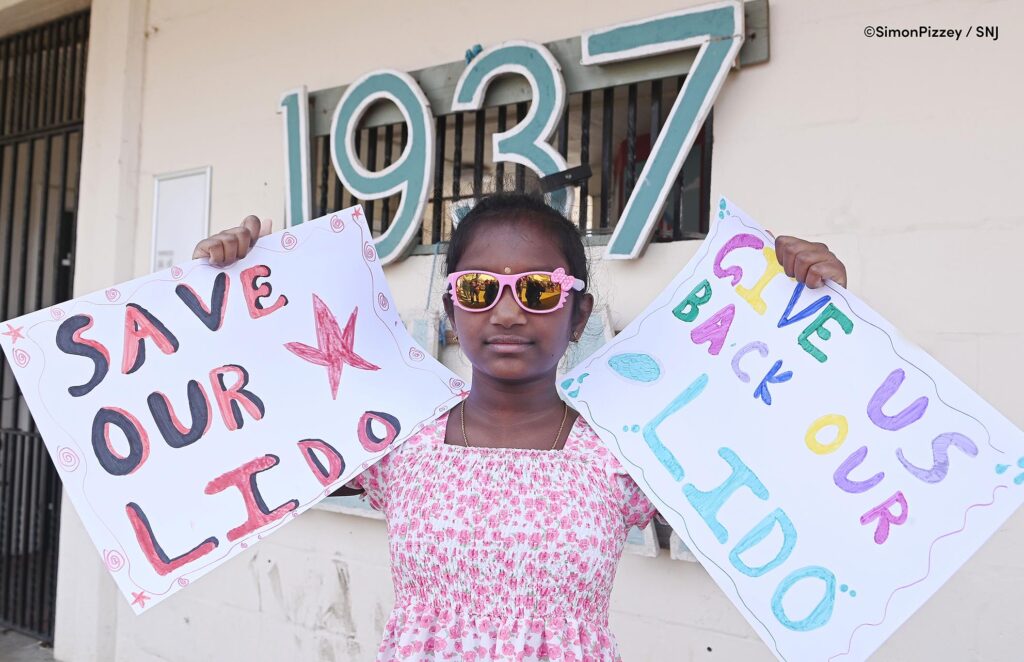
As campaigners we’ve been hearing from people whose families have used the pool for generations and the same words keep coming up. Sanctuary. Haven. Oasis. Lifeline. ‘I feel like I’m on holiday’.
Lidos aren’t just an outdoor version of an indoor pool (though for many swimmers, Stroud’s is simply an altogether nicer, deeper, bigger, less echoey, and less chlorinated place to swim than its very oversubscribed indoor pool).
Summer temperatures are rising, life is not getting any easier for most people, and flights and holidays are becoming increasingly hard to afford for growing numbers of families.
The politicians of the depression era, in the middle of hard times, created accessible and safe places to swim and relax outdoors, places that have brought people together for generations since, around joy and healthy activity.
Will today’s politicians work with the community to protect them?